Alchemist and Spiritual Franciscan Jean de Roquetaillade
(AKA John of Rupescissa) died sometime in 1366. His Handbook in Tribulation predicted that a pair of Antichrists would
emerge in the east and west in 1365 and 70, punishing the world for the sins of
the Church in preparation for an earthly Millennium.
The dualism in John’s prediction could have reflected tensions
in the Church between Rome and France. For
most of the 14th century
the papacy was under the control of a succession of French popes, and had been removed
from the Vatican to Avignon. Indeed, in 1378 – not so long after the time John
predicted for two Antichrists – the Papal Schism began, in which competing popes
claimed legitimacy from both cities. (The schism finally ended in 1417 with the
permanent return of the papacy to Rome.) John himself lived at Avignon from 1349, after going there
to plead his case before Pope Clement VI after a period of imprisonment for the
strenuousness of his attacks against Church abuses. It was there that he did
most of his writing, including the Handbook
in Tribulation.
John’s work in alchemy led him to the first distillation of a
pure solute of ethanol, which he termed aqua vitae or quinta essential, and
touted as a panacea.


6/12/2012
June 12: A Very, Very Long Judgment Day
Christian author Arthur E. Ware published, in 1930, the very
lengthily-titled The hour of Translation: A Declaration from the Word
of God Proving from the State of Things Amongst Men that the Translation
of the Redeemed of Earth Composing the True Church of Jesus Christ, Our
Lord, is Immediately Imminent.
In keeping with his predictions in the book, Ware affirmed that the Tribulation would begin on May 12, 1933 in an interview a week before that date with the London Daily Express.
In keeping with his predictions in the book, Ware affirmed that the Tribulation would begin on May 12, 1933 in an interview a week before that date with the London Daily Express.
6/10/2012
June 10: Beasts of the land and sea, and Wigglesworth's "Doom"
--In 1329, "Spiritual Franciscan" Ubertino da Casale died. His 1305
"Tree of the Crucified Life of Jesus" claimed that the "beasts of the
land and sea" in Revelation were Popes Boniface VIII and Benedict XI.
--In 1705, Michael Wigglesworth died. His 1662 poem "The Day of Doom, or a Poetical Description of the Great and Last Judgment - a Doggerel Epitome of Calvinistic Theology", was an enormous hit in Puritan New England, selling thousands of copies and going on to be widely memorized by children alongside catechism.
--In 1705, Michael Wigglesworth died. His 1662 poem "The Day of Doom, or a Poetical Description of the Great and Last Judgment - a Doggerel Epitome of Calvinistic Theology", was an enormous hit in Puritan New England, selling thousands of copies and going on to be widely memorized by children alongside catechism.
6/09/2012
June 9: The Beast 666 Identified; A Talking Head Misspeaks
The Emperor Nero died today in 68 CE, by suicide, while
fleeing from conspirators. He could not bring himself to perform the act, and
ordered a servant to handle the knife. Nero, beyond any reasonable doubt,
truly was "the Beast 666" of the Book of Revelation, as referred to in
code.
That code is gematria, a kabbalistic study in which words are understood for their numeric value (in Hebrew, the letters of the alphabet double as numbers). The Hebrew transliteration nrwn qsr, or NERON CAESAR, adds to 666 (note that Hebrew also contains no vowels). The second "N" in NERON is an acceptable but unnecessary part of the styling, and this lends further solidity to the case that Nero was "the Beast" - since early, variant texts of Revelation also gave 616 as the number of the beast (the letter "nun" in Hebrew gematria is also the number 50).
No Roman sources mention Jesus or Christianity in any way until around 115 CE. But around that time (115 CE), Tacitus' Histories stated that Nero had blamed Christians for the great fire in Rome in 64. Although it's believed Nero may have had the fire set himself to make room for an extension of his palace, it was Christians who were tortured and executed as punishment for the destruction. Thus, as the first Roman Emperor known to persecute Christians, Nero made his way into the allegorically coded anti-Roman tract known as the Revelation of John of Patmos.
--In 1994, John Hinkle predicted on the Trinity Broadcasting Network that a shattering cataclysm, perhaps a tsunami, would originate in the Pacific Ocean on this date.
That code is gematria, a kabbalistic study in which words are understood for their numeric value (in Hebrew, the letters of the alphabet double as numbers). The Hebrew transliteration nrwn qsr, or NERON CAESAR, adds to 666 (note that Hebrew also contains no vowels). The second "N" in NERON is an acceptable but unnecessary part of the styling, and this lends further solidity to the case that Nero was "the Beast" - since early, variant texts of Revelation also gave 616 as the number of the beast (the letter "nun" in Hebrew gematria is also the number 50).
No Roman sources mention Jesus or Christianity in any way until around 115 CE. But around that time (115 CE), Tacitus' Histories stated that Nero had blamed Christians for the great fire in Rome in 64. Although it's believed Nero may have had the fire set himself to make room for an extension of his palace, it was Christians who were tortured and executed as punishment for the destruction. Thus, as the first Roman Emperor known to persecute Christians, Nero made his way into the allegorically coded anti-Roman tract known as the Revelation of John of Patmos.
--In 1994, John Hinkle predicted on the Trinity Broadcasting Network that a shattering cataclysm, perhaps a tsunami, would originate in the Pacific Ocean on this date.
6/08/2012
June 8: Mohammed, George Sand's Hussite novel
Two dates:
The prophet Mohammed died on this date in 632 CE. A misbelief circulating in Europe - propagated by an unnamed Spanish mystic - held that Mohammed had died in 666. From this it was inferred that he had been the Antichrist, and his passing from earth spelled the imminent return of Christ.
George Sand - the literary pseudonym of Amantine Dupin - died this day in 1876. Messianic themes, mingled with proto-Communist sympathies, appeared in her novels "Consuelo" (1842) and its sequel "The Countess of Rudolstadt", both about the Hussite wars (see May 30, also July 6 forthcoming).
The prophet Mohammed died on this date in 632 CE. A misbelief circulating in Europe - propagated by an unnamed Spanish mystic - held that Mohammed had died in 666. From this it was inferred that he had been the Antichrist, and his passing from earth spelled the imminent return of Christ.
George Sand - the literary pseudonym of Amantine Dupin - died this day in 1876. Messianic themes, mingled with proto-Communist sympathies, appeared in her novels "Consuelo" (1842) and its sequel "The Countess of Rudolstadt", both about the Hussite wars (see May 30, also July 6 forthcoming).
6/06/2012
June 6: K/T and 6/6/6
Two dates for June 6:
--In 1980, "Science" Magazine published a paper called "Extraterrestrial Cause for the Cretaceous-Tertiary Extinction" by Luis and Walter Alvarez. Through analysis of worldwide iridium deposits, they identified the Chicxulub asteroid impact in the Gulf of Mexico 65 million years ago as the cause of the Cretaceous-Tertiary ("K/T") extinction event - in which 75% of all living species were lost over the following 10,000 years.
--In 2006, a remake of the film "The Omen" was released, originally written by David Seltzer in 1976 about the birth and childhood of the Antichrist. The date could be styled 6/6/6, but this was a day that perhaps occasioned less apocalyptic nervousness than it did marketing opportunism.
A new Slayer album originally scheduled for release on this same date was delayed.
--In 1980, "Science" Magazine published a paper called "Extraterrestrial Cause for the Cretaceous-Tertiary Extinction" by Luis and Walter Alvarez. Through analysis of worldwide iridium deposits, they identified the Chicxulub asteroid impact in the Gulf of Mexico 65 million years ago as the cause of the Cretaceous-Tertiary ("K/T") extinction event - in which 75% of all living species were lost over the following 10,000 years.
--In 2006, a remake of the film "The Omen" was released, originally written by David Seltzer in 1976 about the birth and childhood of the Antichrist. The date could be styled 6/6/6, but this was a day that perhaps occasioned less apocalyptic nervousness than it did marketing opportunism.
A new Slayer album originally scheduled for release on this same date was delayed.
6/05/2012
June 5: Gullible Gipper
Ronald Reagan died on this date in 2004. Though he made a number of
remarks during his career suggesting a millennialist outlook, perhaps
Reagan's clearest was at a Sacramento fundraising dinner in September
1971. He was quoted saying: "Armageddon isn't far off. Everything's
falling into place. It can't be long now."
6/04/2012
June 4: An insane asylum is not enough to hold back doomsday
Richard Brothers was a London preacher who convinced a substantial part
of the population that cataclysms would wrack the world on June 4, 1795,
destroying the city in the process. Nervous authorities tried to squelch public hysteria by imprisoning Brothers in an insane asylum.
When the date arrived, large crowds nonetheless fled to the countryside seeking
safety.
6/03/2012
June 3: Pope John XXIII and UFOs
In 1961, a report circulated that Pope John XXIII had been having
visions of doomsday - beginning with Libyan nuclear terrorism in a
European city, continuing with visitations by UFOs made of flaming
steel, and concluding with Christ's reappearance over New York in the
year 2000.
The truth of the report was denied by the Vatican. Pope John XXIII died on this date in 1963.
The truth of the report was denied by the Vatican. Pope John XXIII died on this date in 1963.
6/01/2012
June 1: Justin Martyr, the Beguines, and the Bulletin of the Atomic Scientists
Three dates of note for the first day of June:
--Today is the feast date of the early church father Justin Martyr, beheaded by the urban prefect in Rome in 165. Justin stressed the link between Daniel's prophecies and Christianity by identifying "the son of man" (Daniel 7) with Jesus. Justin was also an early proponent of the largely extra-Biblical concept of the Antichrist.
--Marguerite Porete was burned at the stake in Paris this day in 1310. A member of the persecuted lay order of Beguines, her mystical book "Mirror of the Simple Soul" was condemned for heresy. Preferring a direct, personal relationship with God, elements of the Beguine movement had identified the organized church with Antichrist. However, there may also have been a political dimension to Porete's persecution, occurring four years before Philip The Fair of France would also burn key members of the Knights Templar at the stake in Paris.
--The "Doomsday Clock" was introduced this month in 1947 by the Bulletin of the Atomic Scientists. The clock symbolizes the immanency of nuclear disaster by a minute-hand's proximity to midnight. Over time the count has ranged from 17 minutes (1991) to 2 (1953). The current Executive Director of the "Bulletin", Kennette Benedict, has claimed the current odds of an act of nuclear terrorism occurring in the next 15 years are at least 50%.
--Today is the feast date of the early church father Justin Martyr, beheaded by the urban prefect in Rome in 165. Justin stressed the link between Daniel's prophecies and Christianity by identifying "the son of man" (Daniel 7) with Jesus. Justin was also an early proponent of the largely extra-Biblical concept of the Antichrist.
--Marguerite Porete was burned at the stake in Paris this day in 1310. A member of the persecuted lay order of Beguines, her mystical book "Mirror of the Simple Soul" was condemned for heresy. Preferring a direct, personal relationship with God, elements of the Beguine movement had identified the organized church with Antichrist. However, there may also have been a political dimension to Porete's persecution, occurring four years before Philip The Fair of France would also burn key members of the Knights Templar at the stake in Paris.
--The "Doomsday Clock" was introduced this month in 1947 by the Bulletin of the Atomic Scientists. The clock symbolizes the immanency of nuclear disaster by a minute-hand's proximity to midnight. Over time the count has ranged from 17 minutes (1991) to 2 (1953). The current Executive Director of the "Bulletin", Kennette Benedict, has claimed the current odds of an act of nuclear terrorism occurring in the next 15 years are at least 50%.
5/31/2012
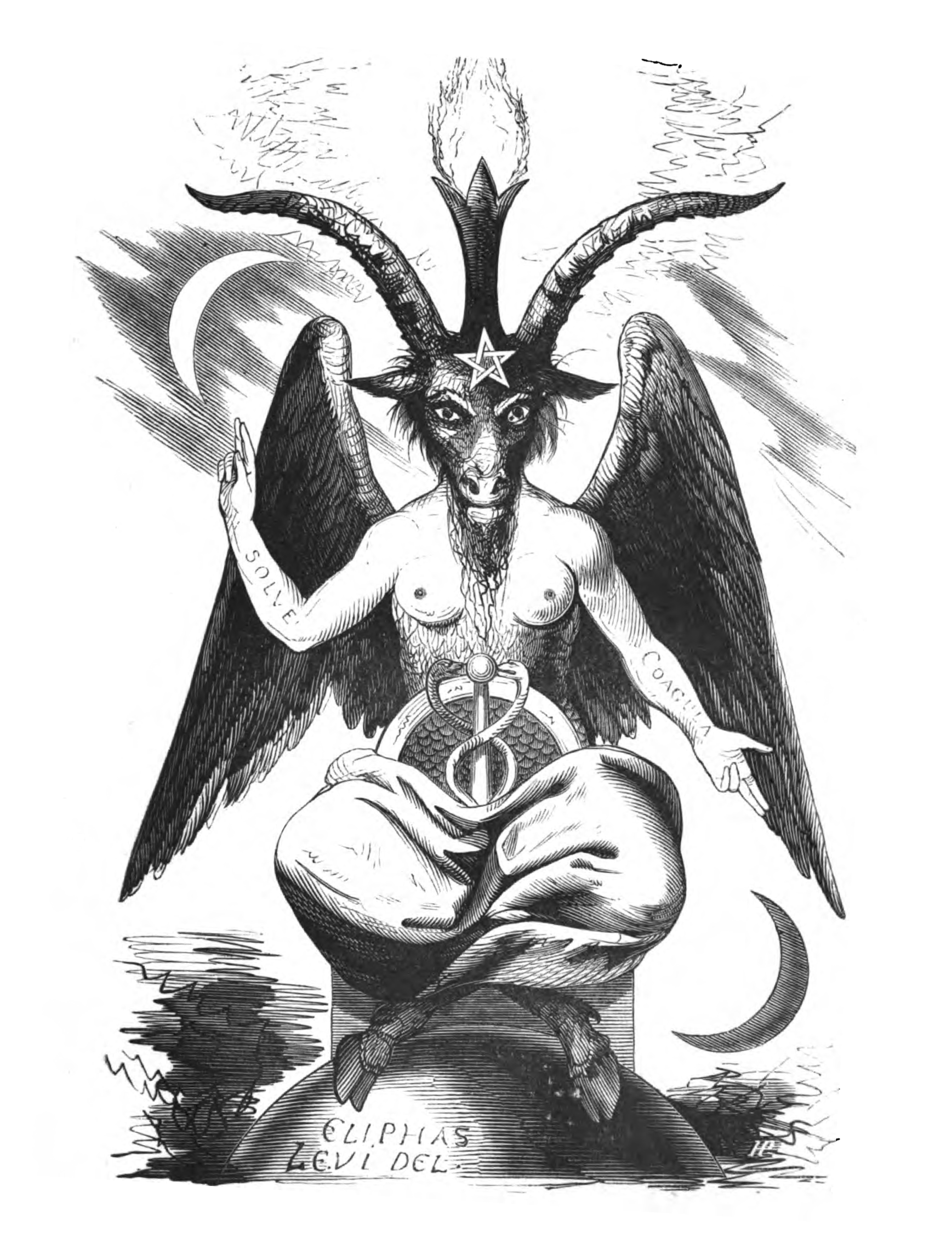
May 31: Eliphas Levi
Eliphas Levi, writing under his birth name of Alphonse-Louis Constant,
published "The Bible of Liberty" in France in 1848. In it he appraised
the Book of Revelation through a triumphal lens of utopian socialism,
seeing its predictions of a Second Coming and New Jerusalem as having a
political dimension, as well as spiritual. The book was considered
radical, and resulted in a brief prison sentence.
Later, under the Hebraicized moniker "Eliphas Levi", Constant went on to focus more on Kabbalah, the occult, and Satanism. He died this day in 1875.

Later, under the Hebraicized moniker "Eliphas Levi", Constant went on to focus more on Kabbalah, the occult, and Satanism. He died this day in 1875.
5/30/2012
May 30: The Taborites, and Joan of Arc
The Taborites were a 15th-century militant faction which split away from the Czech reformists known as Hussites (named for their original leader Jan Hus). The Taborites, influenced by the
medieval apocalypticist Joachim of Fiore and convinced of the imminent return of
Jesus, believed it righteous to kill those who opposed their
theology. They also believed the entire
world would be immolated in 1420, leaving five mountain redoubts spared in all of the earth. One of these would be their own fortification in Bohemia, which they had named "Tabor" (as they had also named themselves) after the
location of Jesus' transfiguration.
The year 1420, however, turned out not to be the date of a world conflagration, but just the beginning of the "Hussite wars" in Czechoslovakia.
On May 30, 1434, the Taborite army was broken (13,000 of 18,000 men killed) by a Catholic league led by the Holy Roman Emperor Sigismund at the Battle of Lipany outside Prague. Within three years, the Taborites signed a treaty with Sigismund and ceased hostilities (although the fortified town of Tabor was captured 20 years following). Separately but around the same time, the Catholic wars with the broader Hussite movement were also brought to an end with the defeat of the Hussites.
***
One opponent of the Hussites and Taborites happened to be Joan of Arc, who wrote them a threatening letter in 1430 claiming she would lead a Crusade into Czechoslovakia unless they rejoined the Church. But this would not come to pass, as Joan was first burned at the stake by the English on this date in 1431. Her victories for Charles VII of France in the Hundred Years' War with England were intended to lay the mere groundwork for a great Crusade into the east - in which not only the Hussites would be defeated, but also the Turks. Her ultimate hope was to recapture Jerusalem for the West and install Charles as the "King of Last Times" in preparation for the return of Jesus.
The year 1420, however, turned out not to be the date of a world conflagration, but just the beginning of the "Hussite wars" in Czechoslovakia.
On May 30, 1434, the Taborite army was broken (13,000 of 18,000 men killed) by a Catholic league led by the Holy Roman Emperor Sigismund at the Battle of Lipany outside Prague. Within three years, the Taborites signed a treaty with Sigismund and ceased hostilities (although the fortified town of Tabor was captured 20 years following). Separately but around the same time, the Catholic wars with the broader Hussite movement were also brought to an end with the defeat of the Hussites.
***
One opponent of the Hussites and Taborites happened to be Joan of Arc, who wrote them a threatening letter in 1430 claiming she would lead a Crusade into Czechoslovakia unless they rejoined the Church. But this would not come to pass, as Joan was first burned at the stake by the English on this date in 1431. Her victories for Charles VII of France in the Hundred Years' War with England were intended to lay the mere groundwork for a great Crusade into the east - in which not only the Hussites would be defeated, but also the Turks. Her ultimate hope was to recapture Jerusalem for the West and install Charles as the "King of Last Times" in preparation for the return of Jesus.
5/29/2012
May 29: Elohim City and Timothy McVeigh
A militant white separatist named Robert Millar founded Elohim City,
Oklahoma in 1972, eventually attracting a population of over 100. Millar
predicted a sequence of disasters beginning with the invasion of the
United States by Asian powers in 2000, followed by natural catastrophes
and the return of Christ.
Questions were raised in the 90s when it came to light that Timothy McVeigh was in contact with a number of residents of Elohim City in the lead-up to the Murrah Federal Building attack. However, none of his contacts were named as co-conspirators.
Robert Millar died this day in 2001.
Questions were raised in the 90s when it came to light that Timothy McVeigh was in contact with a number of residents of Elohim City in the lead-up to the Murrah Federal Building attack. However, none of his contacts were named as co-conspirators.
Robert Millar died this day in 2001.
5/28/2012
May 28: The Greys and Planet X
Informed by her contacts with Zeta Reticulans ("Grey" aliens), Nancy
Lieder predicted Planet X would nearly miss earth on this date in 2003,
causing a 5.9-day cessation in its rotation and global catastrophe.
After the failure of the prediction, the event was moved ahead to 2012
and linked with the close of the Mayan long-count calendar. Michael
Drosnin, author of "The Bible Code", also predicts a comet hit for that
time period.
5/27/2012
May 27: Müntzer and the beginnings of Anabaptism
Thomas Müntzer was an early associate of Martin Luther who broke away in
favor of a new, more radical reform movement called Anabaptism. His
increasingly violent following of a few hundred peasants led a nervous
Duke of Saxony to summon Müntzer for an interview. Müntzer declared
himself to the Duke as a new Daniel, in possession of direct revelations from God, and
urged profound but unspecified changes in German
society. Müntzer narrowly escaped over the town walls that night.
By the following year, 1525, Müntzer found himself at the head of an 8,000-man irregular army of disaffected, apocalypticially-minded peasants. On May 15 they were met outside the city of Frankenhausen by 2000 cavalrymen with cannon support. Rousing his troops for battle, Müntzer declared not just that God would assure their victory, but also that he would personally be able to catch enemy cannonballs in his cloak.
The 2000 cavalrymen killed 5000 of the peasants while sustaining only six casualties of their own. Müntzer caught no cannonballs in his cloak, and was instead found after the rout hiding in an attic nearby. During nearly two weeks of torture, he recanted his entire ministry, begged forgiveness, and accepted Catholic communion before being beheaded on May 27.
The apocalyptic Anabaptist movement, however, would continue bloodily on into the 1530s without Müntzer (see Jan. 22).
By the following year, 1525, Müntzer found himself at the head of an 8,000-man irregular army of disaffected, apocalypticially-minded peasants. On May 15 they were met outside the city of Frankenhausen by 2000 cavalrymen with cannon support. Rousing his troops for battle, Müntzer declared not just that God would assure their victory, but also that he would personally be able to catch enemy cannonballs in his cloak.
The 2000 cavalrymen killed 5000 of the peasants while sustaining only six casualties of their own. Müntzer caught no cannonballs in his cloak, and was instead found after the rout hiding in an attic nearby. During nearly two weeks of torture, he recanted his entire ministry, begged forgiveness, and accepted Catholic communion before being beheaded on May 27.
The apocalyptic Anabaptist movement, however, would continue bloodily on into the 1530s without Müntzer (see Jan. 22).
May 27: A visit to the Cloisters...
Illuminated manuscript of the Apocalypse of John, from Normandy circa
1330. At The Cloisters Museum, New York.


5/26/2012
May 26: The Venerable Bede
The Venerable Bede died this day in the year 735. The Northumbrian monk
and "Father of English History" wrote several works on chronology and
time-reckoning, first popularizing "Anno Domini" as a method of giving
dates (rather than in reference to the reign of a given emperor or
king).
Bede's calculation that the world was created in 3952 BC led others to forecast its end for exactly 6000 years following. Bede also reported in his histories on popular beliefs that the second coming would occur around the year 700.
Bede's calculation that the world was created in 3952 BC led others to forecast its end for exactly 6000 years following. Bede also reported in his histories on popular beliefs that the second coming would occur around the year 700.
5/25/2012
May 25: A pleasant end-of-the-world afternoon at Coney Island
Fifty members of a church called the Assembly of Yahweh gathered at
Coney Island on May 25, 1981, bringing white robes and bongo drums to
await the Rapture sometime between 3pm and sundown.
5/24/2012
May 24: Savonarola
In late 15th-century Florence, the Dominican friar Savonarola preached
the Book of Revelation and the coming of a new Flood - as well as of a new Cyrus (messiah) who would save the Church. By railing
against the exploitation of the poor and against clerical corruption,
Savonarola ran afoul of the two most powerful families in Italy: the
Medici and the Borgias.
The Medici, whose vast banking operations made them de facto rulers of Florence, were ousted from the city ahead of the invading French King Charles VIII. Savonarola supported and celebrated the overthrow, declaring Florence a "New Jerusalem" and organizing a political party and popular reforms. Claiming to have been taken up into heaven where he received a mandate for all this from the Virgin Mary, Savonarola sent patrollers into the streets to enforce morality laws, and organized "bonfires of the vanities" in which items of vice and luxury were publicly destroyed.
Refusing to cooperate with the Borgia Pope Alexander VI's alliance to eject the French from Italy, Savonarola was excommunicated. But he continued writing savage attacks against the Church, and intimated that he could perform miracles. A fellow monk issued a challenge to Savonarola to prove himself in a public trial by fire. The event, after several nervous delays during the appointed day, was eventually botched by rain, and Savonarola's popular power was so diminished that the Pope saw an opportunity to strike. Arrested and tortured, Savonarola confessed that his spiritual visions had all been fraudulent. For this, he and two fellow friars were hanged for heresy and burned in the Piazza della Signoria in Florence on May 23, 1498.
The Medici, whose vast banking operations made them de facto rulers of Florence, were ousted from the city ahead of the invading French King Charles VIII. Savonarola supported and celebrated the overthrow, declaring Florence a "New Jerusalem" and organizing a political party and popular reforms. Claiming to have been taken up into heaven where he received a mandate for all this from the Virgin Mary, Savonarola sent patrollers into the streets to enforce morality laws, and organized "bonfires of the vanities" in which items of vice and luxury were publicly destroyed.
Refusing to cooperate with the Borgia Pope Alexander VI's alliance to eject the French from Italy, Savonarola was excommunicated. But he continued writing savage attacks against the Church, and intimated that he could perform miracles. A fellow monk issued a challenge to Savonarola to prove himself in a public trial by fire. The event, after several nervous delays during the appointed day, was eventually botched by rain, and Savonarola's popular power was so diminished that the Pope saw an opportunity to strike. Arrested and tortured, Savonarola confessed that his spiritual visions had all been fraudulent. For this, he and two fellow friars were hanged for heresy and burned in the Piazza della Signoria in Florence on May 23, 1498.
5/23/2012
May 23: Political radicals of the early 14th century
Fra Dolcino was executed without trial by the Holy See in 1307 by a
brutal, prolonged process of dismemberment. A part of the "Spiritual
Franciscan" movement, Dolcino was an early political radical of sorts
who had created a peasant commune on Mount Rubello in Italy in 1300.
In response to attacks by the Church, as well as by Crusader forces, Dolcino's peasant movement had become murderously violent in something of the way of a modern guerrilla army. 15 years after Dolcino himself was killed, 30 of the remaining Dulcinians were finally rounded up by the Church and burned at the stake in Padua (1322).
Influenced - as were all the spiritual Franciscans - by the medieval apocalypticist Joachim of Fiore, Dolcino predicted around the time of his capture that the world would be overtaken by the Antichrist within three and a half years.
In response to attacks by the Church, as well as by Crusader forces, Dolcino's peasant movement had become murderously violent in something of the way of a modern guerrilla army. 15 years after Dolcino himself was killed, 30 of the remaining Dulcinians were finally rounded up by the Church and burned at the stake in Padua (1322).
Influenced - as were all the spiritual Franciscans - by the medieval apocalypticist Joachim of Fiore, Dolcino predicted around the time of his capture that the world would be overtaken by the Antichrist within three and a half years.
Subscribe to:
Posts (Atom)